
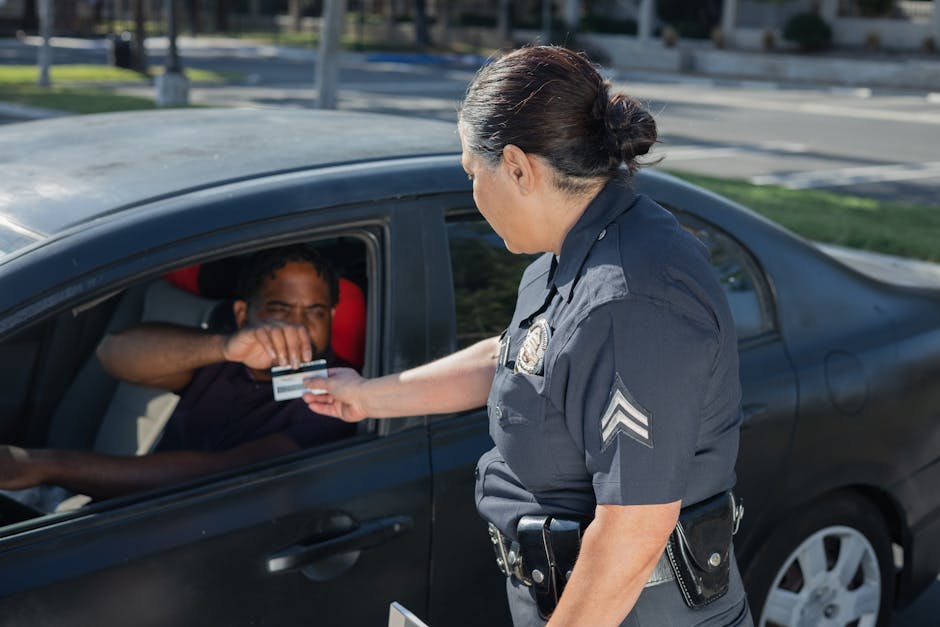
Drunk-driving enforcement in Nassau County runs on geography: the Meadowbrook, Wantagh, Northern State, and Southern State parkways — Robert Moses-era roads with narrow lanes, short ramps, and a summer river of traffic feeding JONES BEACH concerts and beach nights — plus arteries like Sunrise Highway and HEMPSTEAD TURNPIKE, which ranks year after year among the deadliest roads for pedestrians in America. The NASSAU COUNTY POLICE DEPARTMENT, one of the largest county forces in the nation, runs saturation patrols and sobriety checkpoints on these corridors, joined by village police in Freeport, Garden City, Rockville Centre, and elsewhere, and by state troopers on the parkways. A Nassau arrest for driving while intoxicated is arraigned at the FIRST DISTRICT COURT IN HEMPSTEAD, where misdemeanor cases stay; felony DWI — a second offense within ten years, or any Leandra's Law charge — is prosecuted by the Nassau County District Attorney's office in NASSAU COUNTY COURT at the Mineola complex on Supreme Court Drive. Ordinary moving violations follow a different and friendlier path: the NASSAU COUNTY TRAFFIC AND PARKING VIOLATIONS AGENCY, where — unlike New York City's Traffic Violations Bureau, which forbids plea bargaining entirely — negotiated reductions of tickets are part of the daily routine.
New York law — where the offense is called DWI, not DUI — builds a ladder under VEHICLE AND TRAFFIC LAW 1192. DRIVING WHILE ABILITY IMPAIRED (DWAI), at a blood alcohol content of 0.05 to 0.07, is a traffic INFRACTION, not a crime. DRIVING WHILE INTOXICATED — a BAC of 0.08 or higher, or common-law intoxication proven through observation — is an unclassified MISDEMEANOR that creates a permanent criminal record. AGGRAVATED DWI kicks in at 0.18, drug and combined-influence charges run through DRUG RECOGNITION EXPERT testimony, and recidivism escalates fast: a second DWI within ten years is a class E FELONY, a third is a class D. LEANDRA'S LAW adds two hard rules with special resonance in a county of car-seat suburbs: driving intoxicated with a child fifteen or younger aboard is an automatic felony on a first offense, and every misdemeanor-or-higher DWI conviction requires an IGNITION INTERLOCK DEVICE in every vehicle you own or operate for at least twelve months, at your own expense. Drivers under twenty-one face a parallel ZERO TOLERANCE regime: a BAC between 0.02 and 0.07 is handled administratively through a DMV hearing rather than criminal court, but it still costs a six-month license suspension and a civil penalty — a rule with obvious bite in a county where Hofstra, Adelphi, and a dense ring of high schools put young drivers on the parkways every weekend.
The license machinery moves faster than the criminal case, and it is where first-time defendants get hurt. At arraignment in Hempstead, the judge imposes PROMPT SUSPENSION of your license if the breath test showed 0.08 or more — before any conviction — leaving you to request a HARDSHIP PRIVILEGE for essential travel to work, school, or medical care, and then, thirty days in, a PRE-CONVICTION CONDITIONAL LICENSE. If you refused the chemical test, a separate track opens: a DMV REFUSAL HEARING, independent of the criminal court, where the likely outcome is a one-year license revocation plus a five-hundred-dollar civil penalty that stands even if the criminal charge is later dismissed — and the refusal itself is admissible against you at trial. Conviction adds the DRIVER RESPONSIBILITY ASSESSMENT, a three-year state surcharge, and completion of the IMPAIRED DRIVER PROGRAM — available only once every five years — is usually the ticket to a post-conviction conditional license. Commercial drivers face the harshest rule on the books: ANY 1192 conviction, even an infraction-level DWAI in a personal car, triggers a one-year CDL DISQUALIFICATION with no conditional relief, a career-level event for the truck, bus, and delivery drivers who keep Long Island's economy moving.
Local patterns reward local knowledge. Summer weekends produce concentrated enforcement on the Meadowbrook and Wantagh corridors serving Jones Beach; holiday checkpoints cluster on Sunrise Highway and Hempstead Turnpike; and crashes on the pedestrian-heavy stretches of Hempstead Turnpike through Elmont, Franklin Square, and Levittown convert what would be a paperwork case into one with injury counts attached, where the difference between a 0.07 and a 0.08 reading can be the difference between an infraction and years of exposure. The classic first-offense resolution in Nassau, as across New York, is a plea WITHIN section 1192 — New York bars pleading a DWI down to a non-alcohol offense in most circumstances, so DWI-TO-DWAI is the standard outcome for a clean-record defendant with a modest BAC: an infraction instead of a crime, a shorter license sanction, and no interlock. On the pure traffic side, Nassau's TPVA allows the point-reduction bargaining that New York City forbids — a speed in the sixties on the LIE or a red-light allegation in Mineola can often resolve to a lower-point or no-point violation — which matters because eleven points in eighteen months means suspension and six points triggers the Driver Responsibility Assessment. Nassau's separate RED-LIGHT CAMERA program, long controversial for its add-on fees, issues owner-liability tickets that carry no points but accumulate real money, and unpaid camera and TPVA judgments block registration renewals. The parkways add their own quirks: as Robert Moses-era roads they ban trucks and commercial vehicles outright — a box-truck driver who follows GPS onto the Northern State faces both a ticket and a genuine low-bridge hazard — and deer strikes on the parkway corridors generate crash investigations in which any alcohol reading reshapes fault, insurance, and charging decisions simultaneously.
The defense playbook in Nassau is concrete. At the stop: be polite, hand over documents, and decline to answer drinking-history questions — roadside field sobriety tests are optional and graded subjectively on dark parkway shoulders. After arrest: the chemical-test refusal decision is genuinely close and personal, but whatever happened, demand the DMV refusal hearing if one applies, because it doubles as early cross-examination of the arresting officer under oath. In court: CPL Article 245 discovery reform obliges the prosecution to produce calibration records for the breath instrument, maintenance logs, body-camera video, and checkpoint authorization paperwork on a deadline, and Nassau's volume makes compliance failures a live source of dismissals. For representation, defendants who qualify financially are assigned the LEGAL AID SOCIETY OF NASSAU COUNTY or an 18-B panel attorney at the Hempstead arraignment, and the NASSAU COUNTY BAR ASSOCIATION in Mineola — one of the largest suburban bars in the country — runs a lawyer referral service dense with DWI practitioners who know the courtroom-by-courtroom habits of District Court. Two final cautions: never simply pay a TPVA ticket without checking the point and insurance consequences, because a plea by mail is a conviction; and never drive during a suspension period, since AGGRAVATED UNLICENSED OPERATION is a new criminal charge that turns a recoverable situation into a cascading one. And remember that the cheapest defense of all is logistical — the LIRR runs late trains out of Penn Station and Grand Central Madison to nearly every corner of the county, and against the multi-year insurance surcharges, interlock fees, Driver Responsibility Assessments, and legal bills that follow even a reduced Nassau DWI, the train home is the best bargain on Long Island.
Need legal documents for your traffic case?
Hardship license requests, hearing prep forms, and correspondence — state-specific.
Sponsored links. Affiliate disclosure · Compare all options