
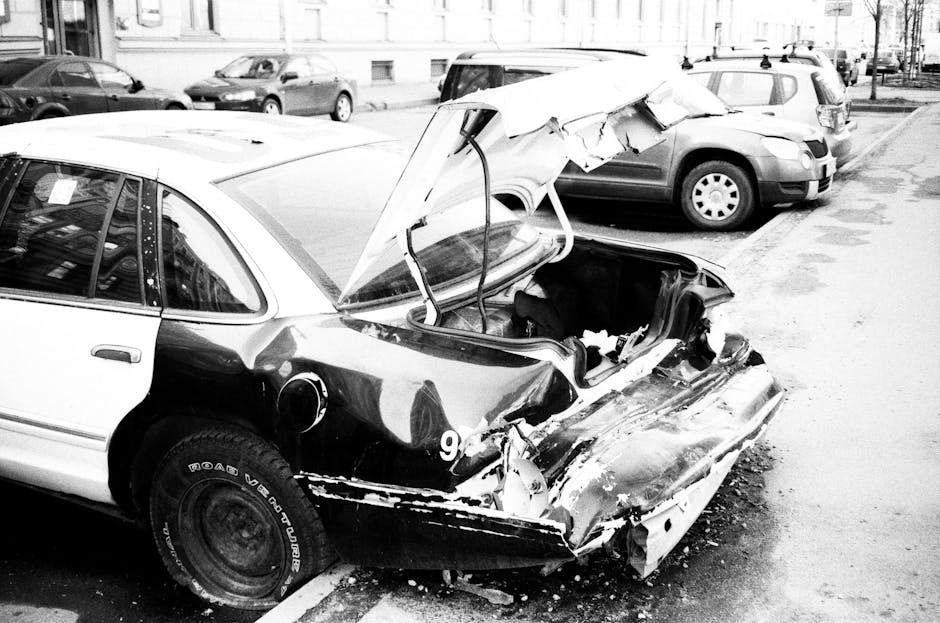
Nassau County drives more miles per capita than almost anywhere in New York, and its road network was built for a different century: the LONG ISLAND EXPRESSWAY (I-495) grinding across the county's spine, the Robert Moses-era parkways — NORTHERN STATE, SOUTHERN STATE, MEADOWBROOK, and WANTAGH — with their banned trucks, low stone overpasses, and deer emerging from the median plantings, SUNRISE HIGHWAY funneling South Shore commerce, and HEMPSTEAD TURNPIKE (NY-24), which year after year ranks among the deadliest roads for pedestrians in the United States. Crash litigation lands in the NASSAU COUNTY SUPREME COURT at 100 Supreme Court Drive in Mineola, seat of the TENTH JUDICIAL DISTRICT, while smaller disputes — property damage, modest injury claims — fit the NASSAU COUNTY DISTRICT COURT, the county's unusual suburban court system with civil jurisdiction to 15,000 dollars and its First District Court in Hempstead. The traffic tickets that so often accompany a crash go somewhere else entirely: the NASSAU COUNTY TRAFFIC AND PARKING VIOLATIONS AGENCY, where — unlike New York City's Traffic Violations Bureau, which forbids plea bargaining — negotiated reductions of moving violations are routine, a distinction that matters both for your license and for how the crash narrative gets locked in.
New York is a NO-FAULT state, and the first month after a Nassau crash is governed by paperwork, not blame. Your own auto insurer — or, if you were a pedestrian or cyclist, the insurer of the vehicle that struck you — pays up to 50,000 DOLLARS in basic PERSONAL INJURY PROTECTION under Regulation 68: medical bills, a substantial share of lost wages, and incidental costs, regardless of who caused the collision. The catch is the clock: the NF-2 APPLICATION for benefits is due to the correct insurer within 30 DAYS of the accident, and medical providers must bill within 45 days, deadlines that carriers enforce ruthlessly. No-fault money is not compensation for pain — to sue for pain and suffering you must clear the SERIOUS INJURY THRESHOLD of INSURANCE LAW 5102(d), a defined list on which a FRACTURE is the bright-line qualifier, alongside significant disfigurement, permanent or significant limitations proven by objective medicine, and the 90/180 category for those disabled from usual activities for 90 of the first 180 days. Disputed no-fault bills go to AAA ARBITRATION, where the filing fee is 40 dollars, the carrier pays your attorney's fee if you win, and overdue benefits accrue interest at 2 percent per month. The lawsuit itself carries a three-year statute of limitations, PURE COMPARATIVE NEGLIGENCE under CPLR 1411 preserves recovery even for a partly-at-fault driver, and VTL 388 makes the vehicle's owner vicariously liable for the driver's negligence — which is why the registered owner is named in nearly every Nassau crash suit.
The county's crash geography is its own body of local knowledge. Hempstead Turnpike's fatal arithmetic — wide crossings, dense retail, transit riders walking the shoulder through Elmont, Franklin Square, Hempstead, East Meadow, and Levittown — produces a steady stream of pedestrian cases in which pure comparative negligence does critical work, because a pedestrian outside the crosswalk is reduced, not barred. The parkways generate their own genres: box trucks and rental vans shorn open by the low bridges after GPS routing failures, deer strikes in the dawn commute, and high-speed weekend runs to Jones Beach that turn the Meadowbrook and Wantagh corridors into a summer enforcement zone for impaired driving. The LIE contributes multi-vehicle chain collisions where fault apportionment among four or five insurers becomes the whole case — and where the event-data recorder in each vehicle may be the only neutral witness to speed and braking. Crash reports come from a patchwork of agencies — the NASSAU COUNTY POLICE DEPARTMENT, one of the largest county police forces in the nation, the many village police departments, and the State Police on the parkways — and identifying which agency wrote your report is step one of every claim. Nassau also runs a long-standing RED-LIGHT CAMERA program whose administrative fees have drawn years of litigation and controversy; camera footage, where it exists, can be decisive evidence, but it is not retained forever and must be requested early.
Who you collide with can matter more than how. A crash with a Nassau County police cruiser, a county ambulance, a NICE bus, a town snowplow, or a school-district vehicle triggers the PUBLIC-ENTITY regime: NOTICE OF CLAIM within 90 DAYS under General Municipal Law 50-e, a 50-h examination, and suit within one year and 90 days — and the substantive standard may shift too, because VTL 1104 holds emergency vehicles in emergency operation to a RECKLESS DISREGARD standard rather than ordinary negligence, and VTL 1103(b) gives snowplows and road-maintenance vehicles similar protection. Road-defect claims on the state parkways or state routes belong in the COURT OF CLAIMS against New York State on its own 90-day rules, while collisions at LIRR grade crossings implicate an MTA railroad with its own claim procedures and short deadlines. On the private side, the essential protection is your own policy: New York mandates UNINSURED MOTORIST coverage at 25/50 minimums, a hit-and-run claim requires a POLICE REPORT WITHIN 24 HOURS, and SUPPLEMENTARY UNINSURED/UNDERINSURED MOTORIST (SUM) coverage is the single most important line item on a Nassau declarations page — on roads full of leased luxury cars and minimum-limits commuters alike, the at-fault driver's 25,000-dollar policy will not rebuild a life, and your own SUM coverage is what fills the gap. Seat-belt nonuse, under long-settled New York law, can reduce damages though it never bars the claim. The county's trauma network — NUMC in East Meadow and North Shore University Hospital in Manhasset, both Level I — receives the worst of it, and if treatment runs through NUMC, remember that the hospital itself is a public benefit corporation with its own 90-day notice rule should care there go wrong.
The playbook for a Nassau crash starts at the scene and runs on deadlines. Call the police and make sure a report is actually written — parkway crashes go to the State Police, village streets to local departments, most of the rest to Nassau County PD — and photograph vehicles, plates, road markings, and injuries before anything moves. Report a hit-and-run within 24 hours to preserve the UM claim. File the NF-2 with the correct carrier inside 30 days, and route every medical bill through no-fault so treatment continues while liability is fought. See a doctor immediately and follow through: the 90/180 threshold category is won or lost on the medical record of the first six months. Decline recorded statements to the other side's insurer. If a municipal or state vehicle was involved, get counsel within days, not weeks — the 90-day notice governs. For insurer misconduct — stalled no-fault payments, unreasonable claim denials — the New York DEPARTMENT OF FINANCIAL SERVICES takes complaints at 1-800-342-3736, and while New York recognizes no private bad-faith lawsuit, a DFS complaint plus the arbitration interest clock changes carrier behavior. For counsel, the NASSAU COUNTY BAR ASSOCIATION's lawyer referral service in Mineola screens by practice area; crash representation is contingency-based, and the earlier the lawyer starts, the more of the evidence — camera footage, event-data recorders, witness memory — survives.
Need legal documents after an accident?
Demand letters, release forms, and settlement agreements — ready in minutes.
Sponsored links. Affiliate disclosure · Compare all options