
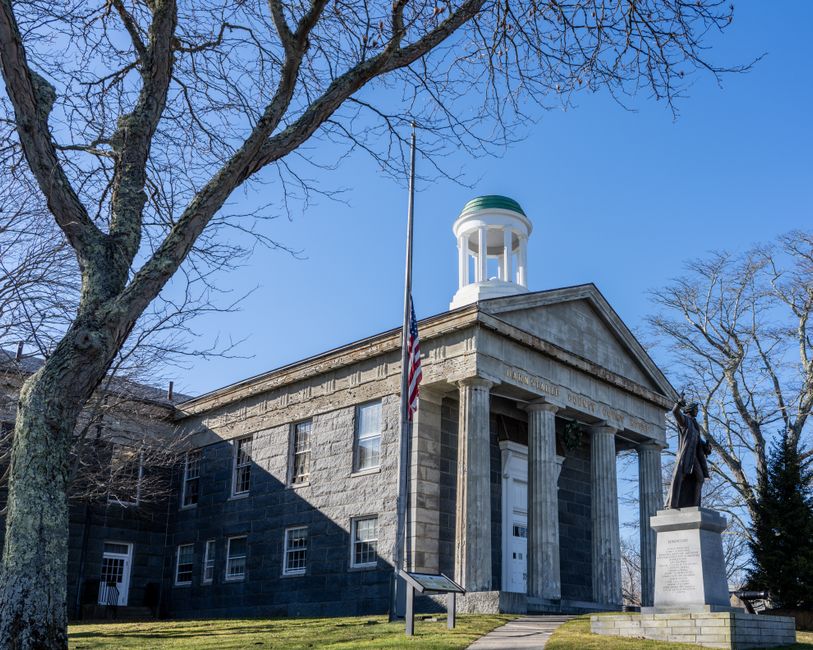
Queens County is the most ethnically diverse county in the United States — roughly 2.3 million residents, about half of them foreign-born, speaking more than 130 languages — and its criminal legal system is built to that scale. Nearly every state criminal case in the borough runs through the courthouse complex in KEW GARDENS: the QUEENS COUNTY CRIMINAL COURT at 125-01 QUEENS BOULEVARD handles around-the-clock arraignments, misdemeanor cases, and the front end of felony prosecutions, while the SUPREME COURT, CRIMINAL TERM in the same Kew Gardens complex tries indicted felonies before Queens juries drawn from Flushing, Jackson Heights, Jamaica, Astoria, the Rockaways, and everywhere in between. The QUEENS COUNTY DISTRICT ATTORNEY — Melinda Katz, as of early 2026 — prosecutes state charges, while federal cases arising in the borough, including the steady stream of drug-importation, smuggling, and fraud arrests at JFK Airport, are prosecuted in the EASTERN DISTRICT OF NEW YORK, whose courthouse sits across the borough line in Brooklyn. Anyone held before trial goes to RIKERS ISLAND, and anyone who needs an interpreter is entitled to one — Queens arraignment parts work through Spanish, Mandarin, Cantonese, Korean, Bengali, Punjabi, Haitian Creole, and dozens of other languages every single day.
The governing law is New York's, and three post-2019 reforms define how Queens cases actually move. First, BAIL REFORM: for most misdemeanors and nonviolent felonies, judges may not set cash bail at all — release on recognizance or supervised release is the norm, and bail or remand is reserved for qualifying offenses such as most violent felonies, certain repeat offenses, and domestic-violence charges. Second, CPL ARTICLE 245 DISCOVERY REFORM: prosecutors must disclose their evidence — police reports, body-worn camera footage, lab results, witness information — and certify that disclosure in a CERTIFICATE OF COMPLIANCE before they can validly announce readiness for trial, which means discovery failures now produce real CPL 30.30 SPEEDY-TRIAL DISMISSALS, a genuine lever in high-volume Queens Criminal Court parts — the readiness clock runs 90 days on most misdemeanors and six months on felonies, and CPL 180.80 separately requires release of a detained defendant if the grand jury does not act within roughly five days of arrest. Third, DESK APPEARANCE TICKETS: many misdemeanor arrests in Queens end not in central booking but in a DAT ordering the person to appear at 125-01 Queens Boulevard weeks later — the case is every bit a real criminal prosecution, and missing the return date converts a manageable charge into a bench warrant. On the substantive side, New York recognizes NO STAND-YOUR-GROUND rule: outside the home there is a DUTY TO RETREAT before using deadly force if retreat is safely possible, though the CASTLE DOCTRINE preserves the right to defend against intruders inside one's own dwelling.
Two local patterns dominate Queens defense work. The first is immigration: in a borough where half the population was born abroad — the Chinese and Korean communities of Flushing, the South Asian and Latin American blocks of Jackson Heights, the Punjabi Sikh and Indo-Caribbean enclaves of Richmond Hill, the Bangladeshi community of Ozone Park, the Mexican and Ecuadorian neighborhoods of Corona and Elmhurst — nearly every plea carries potential immigration freight. Under PADILLA v. KENTUCKY, defense counsel must advise noncitizen clients about deportation consequences, and a plea that looks trivially small in criminal terms can trigger removability, destroy a pending green-card or naturalization application, or bar reentry. Queens has no immigration court of its own — respondents travel to 26 FEDERAL PLAZA in Manhattan — but NYIFUP, the New York Immigrant Family Unity Project, provides free public defenders for detained immigrants, and New York City's SANCTUARY rules sharply limit when the city honors ICE detainers. The second pattern is guns: New York requires a license to possess a handgun, the CONCEALED CARRY IMPROVEMENT ACT bans carry in a long list of sensitive locations, and OUT-OF-STATE PERMITS ARE VOID here — which is why travelers who lawfully check a firearm in Georgia or Texas and declare it at a JFK or LaGuardia ticket counter are routinely arrested by PORT AUTHORITY POLICE and charged with CRIMINAL POSSESSION OF A WEAPON, a felony framework carrying a presumptive 3.5-year state prison term for loaded, unlicensed handguns. Cannabis, by contrast, is legal for adults 21 and over under the MRTA — up to three ounces — and the odor of marijuana no longer justifies most vehicle searches, though unlicensed sale and impaired driving remain crimes, a distinction that matters along the vendor and nightlife corridors of Roosevelt Avenue.
The institutional map matters. Public defense in Queens is provided primarily by the LEGAL AID SOCIETY and QUEENS DEFENDERS, with assigned 18-B counsel filling conflicts — representation is free at arraignment for anyone who cannot afford a lawyer, no immigration status questions asked. Grand juries sit in the Kew Gardens complex, and the same buildings house specialized problem-solving parts — drug-treatment diversion, mental-health, veterans, and human-trafficking intervention courts — which can resolve cases through treatment rather than jail, an option defense counsel should press for early because eligibility decisions are made at the front of a case, not the end. IDNYC, the free municipal identification card, is accepted across city agencies and matters at arraignment for the many Queens residents who lack state-issued ID. Sixteen- and seventeen-year-olds are handled under RAISE THE AGE, with most adolescent cases routed toward the youth part or QUEENS FAMILY COURT at 151-20 JAMAICA AVENUE. And because a Queens conviction follows a person into the nation's most competitive housing and labor markets, New York City's civil protections matter as much as the sentence: the NYC FAIR CHANCE ACT forbids most employers from asking about criminal history until after a conditional job offer and requires an individualized analysis before withdrawing it, FAIR CHANCE FOR HOUSING now restricts criminal-background screening by most landlords, and CORRECTION LAW ARTICLE 23-A bars public and private employers and licensing agencies from denying jobs or licenses because of a conviction absent a direct relationship or genuine risk.
The practical playbook: say nothing to police beyond identifying yourself and ask for a lawyer — in every language Queens speaks, the words are the same. Never miss a court date at 125-01 Queens Boulevard, DAT or otherwise. Tell your defense lawyer your true immigration status immediately so any plea can be structured around it. After the case ends, New York now offers real second-chance machinery: the CLEAN SLATE ACT, effective November 2024, automatically seals eligible misdemeanor convictions three years — and eligible felony convictions eight years — after sentencing or release from incarceration, provided the person stays off supervision and conviction-free, with sex offenses and most class A felonies excluded; sealed records become invisible to landlords and most employers but remain visible to immigration authorities, gun licensing, and sensitive-job screening. Older or excluded cases may qualify for CPL 160.59 PETITION SEALING after ten years for up to two convictions, at most one a felony, and CERTIFICATES OF RELIEF FROM DISABILITIES or GOOD CONDUCT can restore rights and rebut licensing bars sooner. In a borough where a single conviction can ripple through a family's immigration file, a taxi license, an airport security clearance, and a co-op board application all at once, Queens defense is practiced as damage control across an entire life — and the earlier counsel gets involved, the more of that life gets protected.
Need legal documents for your defense?
Character references, release forms, and legal correspondence templates.
Sponsored links. Affiliate disclosure · Compare all options