
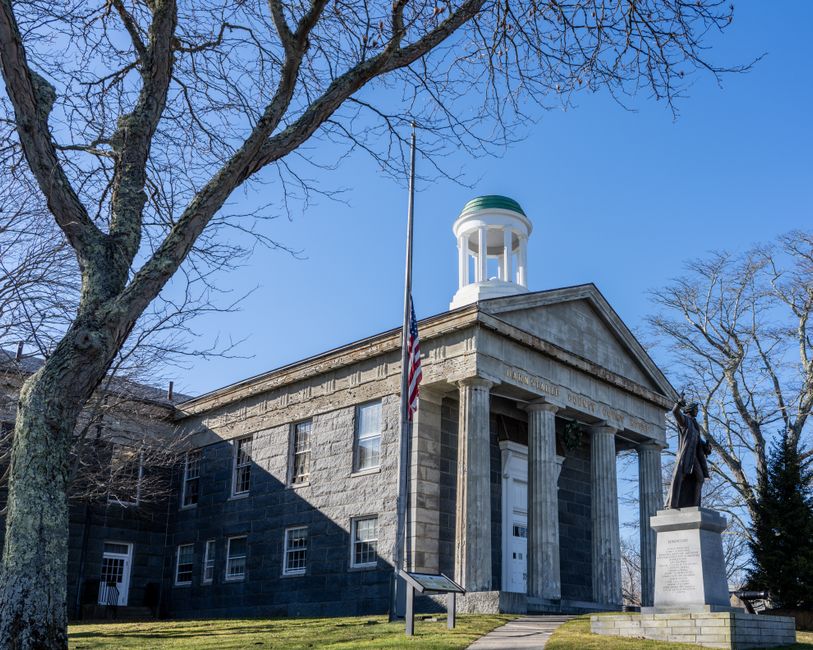
Criminal justice in Bronx County happens along a two-block stretch of East 161st Street that may be the busiest criminal-law corridor in America. Arrests are arraigned at BRONX CRIMINAL COURT, 215 East 161st Street — New York law requires arraignment without unnecessary delay, in practice within roughly 24 hours of arrest, seven days a week — while felonies that survive the early stages move to the Supreme Court, Criminal Term at the BRONX HALL OF JUSTICE, 265 East 161st Street, the glass courthouse across the street. The BRONX DISTRICT ATTORNEY (Darcel Clark, the borough's first woman DA) prosecutes from 198 East 161st Street. Defense for the roughly nine in ten defendants who cannot afford counsel is split between two institutional providers whose Bronx offices are nationally known: THE BRONX DEFENDERS (360 East 161st Street; 718-838-7878) — the office that invented and exported the HOLISTIC DEFENSE model, wrapping criminal representation together with immigration counsel, civil attorneys for the housing and employment fallout, family-defense lawyers for any ACS case, and social workers — and THE LEGAL AID SOCIETY, the city's primary defender, with 18-B panel attorneys taking conflict cases. This borough also carries a piece of criminal-justice geography most residents don't realize: RIKERS ISLAND is legally part of Bronx County, so the city's jail complex — and the litigation over what happens inside it — sits within this county's jurisdiction, and a Bronx case that ends in remand means a bus to Rikers, not a local jail.
New York's post-2019 procedural reforms — several of them written in the Bronx's image — govern every case. BAIL REFORM eliminated cash bail for most misdemeanors and nonviolent felonies: for those charges, judges must release defendants on recognizance or under supervised release conditions, reserving bail and remand for "qualifying offenses" (violent felonies, certain repeat offenses, DV-adjacent charges — categories the Legislature has repeatedly adjusted since 2020, giving judges more discretion at the margins). When bail IS set, New York judges may consider only risk of flight, not "dangerousness" — a rule unique among the states. DISCOVERY REFORM (CPL Article 245) demolished the old "blindfold": prosecutors must disclose their evidence — police reports, body-worn camera footage, witness statements, 911 audio — automatically and early, within 20 to 35 days of arraignment in most postures, and must certify compliance before they can be ready for trial. SPEEDY-TRIAL LAW (CPL 30.30) requires prosecution readiness within 90 days on misdemeanors and six months on felonies, with defective discovery certificates invalidating readiness — a daily battleground at 215 East 161st, and a reform with a Bronx name behind it: KALIEF BROWDER, the Bronx teenager who spent three years on Rikers awaiting trial on a bookbag-theft accusation that was ultimately dismissed, whose death drove the discovery, speedy-trial, and Raise the Age changes and the ongoing (much-delayed) plan to close Rikers. Lower-level arrests now typically produce a DESK APPEARANCE TICKET (DAT) — release from the precinct with a future arraignment date — rather than a night in central booking; treat a DAT as the criminal case it is, with a lawyer at the first appearance.
The Bronx docket has a recognizable shape. GUN CASES dominate the serious end: criminal possession of a loaded firearm without a license (Penal Law §265.03) is a class C VIOLENT felony carrying a presumptive 3½-year minimum prison term even for first arrests — a trap for out-of-state visitors with carry permits from elsewhere (New York honors none) and for residents who never navigated the NYPD's licensing system, which even after the Supreme Court's Bruen decision and the state's responsive Concealed Carry Improvement Act remains among the nation's strictest (training, character review, and long sensitive-location lists). Defense in gun cases is overwhelmingly SUPPRESSION litigation — the stop, the frisk, the car search, the apartment entry — and Bronx courts, with the borough's stop-and-frisk history in living memory, take Fourth Amendment hearings seriously; Bronx juries are famously willing to hold police testimony to its proof. MARIJUANA is legal for adults 21+ (MRTA, 2021) — possession up to three ounces, smoking wherever tobacco is lawful, past convictions automatically expunged — though unlicensed sale and driving-while-impaired remain chargeable. DOMESTIC VIOLENCE cases run through dedicated DV parts with mandatory-arrest policies, orders of protection at arraignment (often full stay-away orders that exclude defendants from their own homes — housing counsel matters immediately), and evidence-based prosecution that proceeds without the complainant when necessary. Raise the Age routed 16- and 17-year-olds to the YOUTH PART or Family Court, with detention at the Horizon Juvenile Center in Mott Haven rather than Rikers; adolescent records carry sealing and youthful-offender protections a knowledgeable lawyer preserves from day one.
What happens after the plea or verdict matters as much in the Bronx as the case itself. NEW YORK HAS NO STAND-YOUR-GROUND LAW: outside your home you have a DUTY TO RETREAT before using deadly force if you can do so safely (the castle doctrine excuses retreat inside your own dwelling) — a distinction that decides self-defense claims arising from the borough's street disputes, and one that surprises defendants raised on other states' rules. COLLATERAL CONSEQUENCES are the holistic-defense battleground: a conviction can trigger NYCHA termination proceedings against an entire family (public-housing exclusion rules reach conduct by household members and guests), immigration detention and removal (every noncitizen defendant needs Padilla-compliant advice BEFORE any plea — the Bronx Defenders' integrated immigration unit exists precisely because a "good deal" of 30 days can be a deportation order in disguise), professional and TLC license loss (livery drivers), and employment screening — though NYC's Fair Chance Act bars most conviction inquiries until after a conditional job offer and requires individualized analysis. SEALING has two tracks: CPL 160.59 (petition-based: up to two eligible convictions, one felony maximum, after ten crime-free years) and the CLEAN SLATE ACT (effective November 2024: AUTOMATIC sealing of most misdemeanors three years, and most felonies eight years, after sentence or release from incarceration — excluding sex offenses and class A felonies — with no petition required once conditions are met, though implementation runs in phases). ALTERNATIVES TO INCARCERATION are unusually developed here: judicial diversion for eligible felony drug cases (CPL Article 216), the Bronx's treatment courts (drug, mental health, veterans), and BRONX COMMUNITY SOLUTIONS, which supplies judges borough-wide with community-service and social-service sentencing options that resolve thousands of misdemeanors without jail or lasting records.
If the arrest is happening now, the script is short: say "I AM NOT ANSWERING QUESTIONS AND I WANT A LAWYER," then stop talking — to police, to cellmates, and on the recorded phones at Rikers and the precinct (calls are evidence; more Bronx cases are sunk by jail calls than by witnesses). Do not consent to searches of your person, car, home, or PHONE. At arraignment you will have a lawyer — Bronx Defenders or Legal Aid by rotation, free, and among the best public defense in the country; families should show up with proof of address and employment (release arguments) and say nothing about facts in the gallery or on the phones. If a detective calls "just to hear your side," the answer is your lawyer's phone number: pre-arrest interviews convert defendable cases into confessions daily. For those who can retain counsel, the BRONX COUNTY BAR ASSOCIATION (718-293-5600) refers criminal specialists; retained fees range from four figures for misdemeanors to five-plus for felony trials — but retained is not automatically better than the institutional defenders in THIS county, whose lawyers try more Bronx cases than anyone. Afterward: show up to every date (a bench warrant converts anything into jail), keep the order of protection's exact terms (the complainant cannot "waive" it — only the judge can modify), collect your property-voucher paperwork (Bronx Defenders' civil team litigates NYPD property retention), and calendar the sealing dates — Clean Slate runs automatically, but verifying the record actually sealed (and fixing DCJS errors) is worth one lawyer letter. The Bronx is a hard place to be arrested — and, because of the reforms it forced and the defenders it built, one of the best-defended places in America to fight a case.
Need legal documents for your defense?
Character references, release forms, and legal correspondence templates.
Sponsored links. Affiliate disclosure · Compare all options