
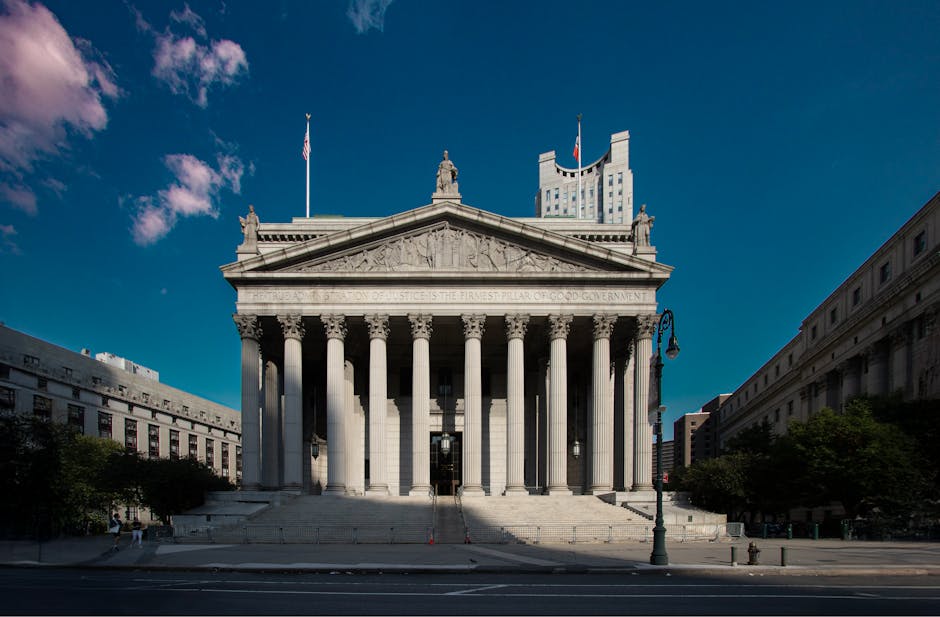
A criminal case arising in the City of Miami is prosecuted by the State Attorney for the Eleventh Judicial Circuit and heard at the Richard E. Gerstein Justice Building (1351 NW 12th St.), just west of the Health District, with records kept by the Miami-Dade Clerk of Courts. Most City of Miami arrests are made by the City of Miami Police Department — the city's own force, distinct from the county's Miami-Dade Police — though state and federal agencies also make arrests within the city, and Florida Highway Patrol handles expressway offenses. Arrestees are booked into the county jail system (primarily the Turner Guilford Knight Correctional Center) and see a judge for a first-appearance and bond hearing within 24 hours, where bond, pretrial-release conditions, or pretrial detention are set. The Miami-Dade Public Defender's Office represents defendants who cannot afford counsel — a constitutional right — and the courts provide Spanish and Haitian Creole interpreters at every stage, a necessity in a city where most defendants' first language is not English. City of Miami municipal ordinances (open-container, noise, and code offenses in the entertainment districts) are enforced by city police but jailable and serious cases move to the circuit's criminal courts.
Florida grades crimes from second-degree misdemeanors through capital felonies, with felony sentencing driven by the Criminal Punishment Code scoresheet and a web of enhancements (10-20-Life for firearms, habitual-offender designations) that transform exposure. Two Florida doctrines run through nearly every city case. First, the WITHHOLD OF ADJUDICATION (Fla. Stat. §948.01): a judge can impose probation without formally adjudicating guilt, so the defendant is not convicted under Florida law, which preserves civil rights and sometimes sealing eligibility. Second — and this is decisive in a majority-immigrant city — the immigration overlay: for many Little Havana, Little Haiti, and Allapattah defendants the most important consequence of a case is not the sentence but the immigration effect, and a Florida withhold is still a CONVICTION under federal immigration law when there is a plea or finding of guilt plus any punishment or restraint. Under Padilla v. Kentucky, defense counsel must advise noncitizens of the immigration consequences, and competent Miami practice means structuring pleas — the specific statute, the sentence length, the factual basis — around deportability and inadmissibility grounds, not just around jail time.
Miami-Dade pioneered the modern diversion movement, and City of Miami defendants benefit from the deepest menu of alternatives in the state: the county created the nation's first DRUG COURT in 1989, the Eleventh Circuit's CRIMINAL MENTAL HEALTH PROJECT is nationally recognized for diverting defendants with serious mental illness out of the jail and into treatment, and the State Attorney's Office runs pretrial diversion for many first-time misdemeanor and nonviolent felony charges (completion ends in dismissal), plus veterans court and specialized dockets. For eligible defendants these programs are usually the best available outcome — dismissal rather than a record — but eligibility rules, admission-of-responsibility requirements, and immigration implications need a defense lawyer's analysis before enrollment, because some programs require admissions that can count against a noncitizen. Florida's Stand Your Ground law (Fla. Stat. §776.012 through §776.032) eliminates the duty to retreat and provides pretrial IMMUNITY: a defendant claiming lawful self-defense gets an evidentiary hearing at which the STATE bears the burden of overcoming the immunity claim, a vehicle that can end a case before trial.
Constitutional defense work in the city runs through suppression. Fourth Amendment challenges target vehicle stops (a large share of cases begin with a traffic stop on Biscayne Boulevard, Calle Ocho, or an I-95 ramp), searches of cars and homes, stop-and-frisk encounters in Overtown and Liberty City, and the city's dense license-plate-reader and camera network; Fifth Amendment challenges attack statements taken without proper Miranda warnings, with language a recurring issue, because warnings and interrogations conducted in a suspect's second language generate genuine voluntariness and comprehension litigation; and reliability challenges target eyewitness identifications. Domestic-violence charges follow their own track: a mandatory no-contact condition at first appearance can exclude a defendant from a shared home, the State Attorney prosecutes even when the complainant recants because the case belongs to the State rather than the alleged victim, and collateral consequences include firearm prohibitions and a parallel injunction proceeding. Never violate a no-contact order to work things out — every jail call is recorded, and a message to the complainant becomes both a new charge and the State's best evidence.
Florida's record-clearing rules are stingy and should shape plea strategy from the start. A person may SEAL a record where adjudication was withheld on an eligible offense, or EXPUNGE one where charges were dropped, dismissed, or ended in acquittal — but only ONCE in a lifetime, only for one arrest event with narrow exceptions, never for an actual conviction, and never for a long list of disqualifying offenses regardless of a withhold, with the process running through a Certificate of Eligibility from the Florida Department of Law Enforcement before a court petition. Because the once-per-lifetime rule forces a choice, and because a withhold that helps under Florida law can still devastate immigration status, the time to think about the record is at the PLEA, not years later. For help, the Miami-Dade Public Defender's Office represents qualifying defendants from first appearance, private defense counsel concentrate around the Gerstein building, the Dade County Bar referral service (305-371-2220) lists defense specialists, and for the immigration dimension — often the decisive one for city defendants — Americans for Immigrant Justice (305-573-1106) and Catholic Legal Services (305-373-1073) coordinate with defense counsel, because in this city a criminal case handled without immigration analysis is a case half-defended.
Need legal documents for your defense?
Character references, release forms, and legal correspondence templates.
Sponsored links. Affiliate disclosure · Compare all options