
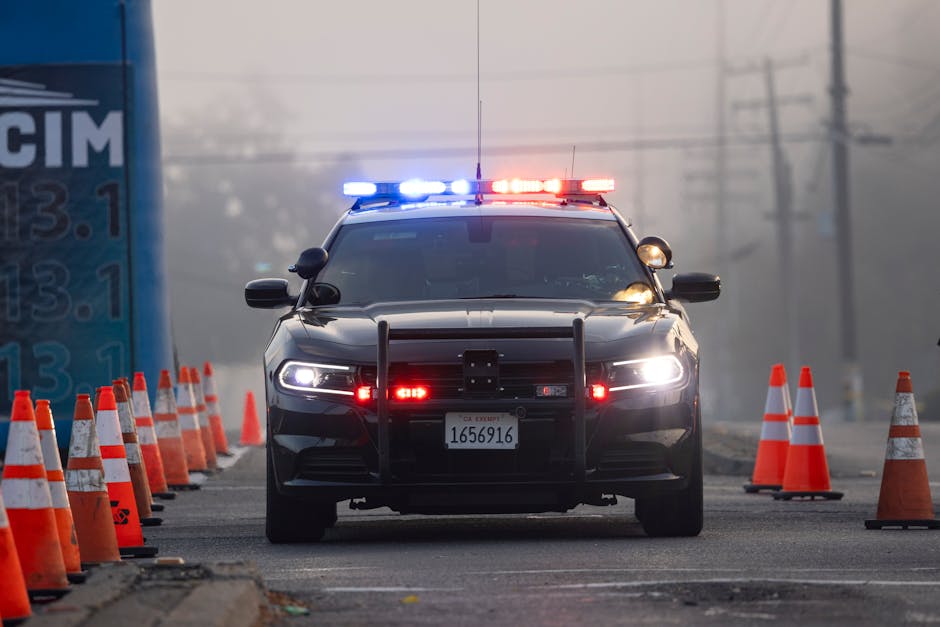
DUI arrests in SAN JOSE are made by the SAN JOSE POLICE DEPARTMENT and, on the freeways, by the CALIFORNIA HIGHWAY PATROL, then processed through the county's criminal courts — most matters at the HALL OF JUSTICE (190 W. Hedding St.) just north of downtown. California's DUI law under VEHICLE CODE 23152 makes it illegal to drive with a blood alcohol concentration of 0.08 PERCENT or higher — 0.04 percent for commercial drivers and a zero-tolerance 0.01 percent for drivers under 21 — and a charge can rest on the number alone under subdivision (b) or on evidence of impairment under subdivision (a) regardless of the exact reading. San Jose enforcement concentrates where the drinking is: the downtown core, the SANTANA ROW dining-and-nightlife district, and the SAN JOSE STATE UNIVERSITY area on weekend nights, plus saturation patrols and holiday-weekend CHECKPOINTS along the freeway corridors and the wide arterials that carry people home. A DUI arrest launches two separate proceedings at once — a criminal case and an administrative license case — and confusing the two is how San Jose drivers lose their licenses without ever seeing a judge.
The administrative track is the one that ambushes people. Under California's ADMINISTRATIVE PER SE (APS) process, the DMV moves to suspend the license of any driver who tested at or above the limit or refused testing — a suspension entirely separate from the criminal case and imposed by the DMV, not the court. The driver has only 10 DAYS from the date of arrest to REQUEST A DMV HEARING contesting that suspension, and missing that window means an automatic suspension takes effect regardless of how the criminal case turns out. This 10-day deadline is the single most-missed deadline in California DUI practice, and it is often the most urgent task facing a newly arrested San Jose driver — more time-sensitive, in the first days, than the criminal case itself. The DMV hearing is a narrower proceeding than the trial, focused on whether the stop was lawful and whether the testing was properly done, and it can be requested through the DMV's Driver Safety Office serving the San Jose area.
A first-offense DUI in San Jose typically carries three to five years of summary probation, completion of a state-licensed DUI EDUCATION PROGRAM under AB 541 (three, six, or nine months depending on the BAC level and history), fines and penalty assessments that commonly total in the low thousands of dollars, and a license suspension — though many first offenders can obtain a RESTRICTED LICENSE to keep driving once they install an IGNITION INTERLOCK DEVICE (IID), which California requires broadly. A common and important outcome is the WET RECKLESS plea under VEHICLE CODE 23103.5 — a negotiated reduction from a DUI to a reckless-driving charge noting alcohol involvement, which carries lighter penalties, a shorter program, and less stigma, though it still counts as a PRIOR under California's 10-YEAR LOOKBACK if the driver is arrested again. That lookback matters enormously in this city, because a second DUI within ten years carries mandatory jail and a longer suspension, and the stakes rise from there. For San Jose's large immigrant population, a standard first DUI rarely triggers deportation by itself, but a drug-DUI or a DUI paired with other charges can carry immigration consequences worth reviewing with counsel, and a DUI can also jeopardize professional licenses and security-sensitive tech jobs.
Repeat and injury DUIs escalate sharply. A DUI causing bodily injury to another person under VEHICLE CODE 23153 is a wobbler that can be charged as a FELONY, particularly where the injuries are serious, and a fourth DUI within ten years is a felony as well. In the gravest cases, California prosecutors — Santa Clara County's included — can charge SECOND-DEGREE MURDER, known as a WATSON MURDER, when a driver with a prior DUI conviction and a documented Watson advisement kills someone while driving impaired. San Jose's freeway network and its wide, fast arterials make injury collisions a real risk, and the DA's office pursues serious impaired-driving cases vigorously. Effective DUI defense in San Jose frequently turns on challenging the legality of the traffic stop, the calibration and maintenance records of the breath machine or the handling of the blood draw, and the administration of the field sobriety tests — all of which require prompt investigation before squad-car and body-worn-camera video is overwritten. A skilled defense can mean the difference between a DUI conviction and a wet-reckless resolution, or between a felony and a misdemeanor.
Beyond DUI, San Jose's traffic courts process an enormous volume of moving violations — speeding on US-101, INTERSTATE 280, and the city's arterials, running red lights, and unsafe driving — cited by SJPD and CHP. Many infractions can be kept off the driving record through TRAFFIC SCHOOL, available once every 18 months under VEHICLE CODE 41501, or contested through an informal trial or a TRIAL BY WRITTEN DECLARATION that lets a driver submit a defense in writing without appearing. Fix-it tickets for correctable violations like expired registration or a broken light can usually be dismissed with proof of correction. But repeated violations in a short window stack points under the DMV's NEGLIGENT-OPERATOR system, which can suspend a license independent of any single ticket. For a DUI or a serious traffic charge, the SANTA CLARA COUNTY PUBLIC DEFENDER represents qualifying defendants who cannot afford private counsel, and the SANTA CLARA COUNTY BAR ASSOCIATION Lawyer Referral Service (408-287-2557) connects drivers with DUI attorneys — worth doing quickly, given that 10-day DMV clock ticking from the moment of arrest.
Need legal documents for your traffic case?
Hardship license requests, hearing prep forms, and correspondence — state-specific.
Sponsored links. Affiliate disclosure · Compare all options