
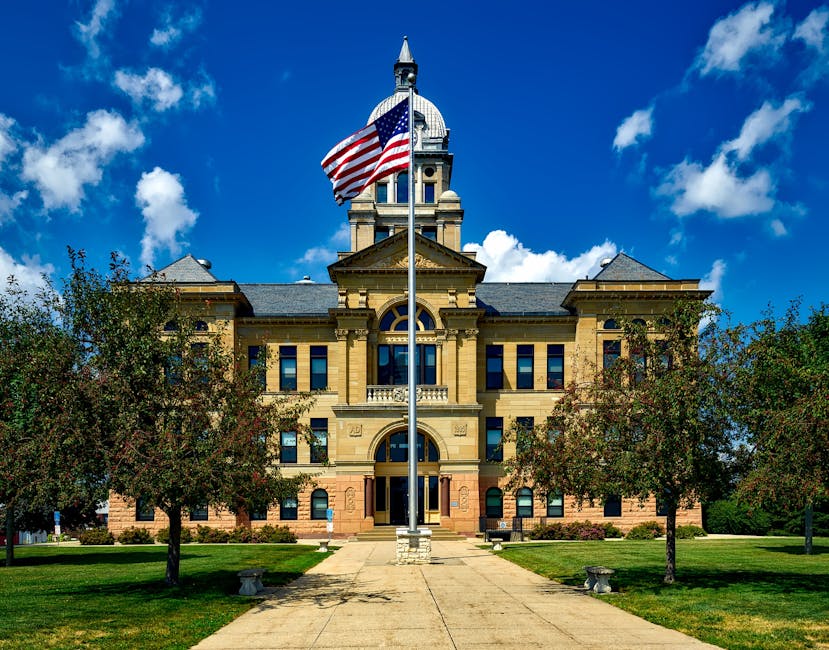
A criminal case in CHAMPAIGN runs through the CIRCUIT COURT OF CHAMPAIGN COUNTY, the trial court of the SIXTH JUDICIAL CIRCUIT, which sits at the CHAMPAIGN COUNTY COURTHOUSE at 101 E. Main Street in URBANA — the county seat — beside the Champaign County correctional facilities where pretrial detainees are held. Charging decisions rest with the CHAMPAIGN COUNTY STATE'S ATTORNEY, and defendants who cannot afford counsel are represented by the CHAMPAIGN COUNTY PUBLIC DEFENDER. Four law-enforcement agencies feed the docket: the CHAMPAIGN POLICE DEPARTMENT in the City of Champaign, the URBANA POLICE, the UNIVERSITY OF ILLINOIS POLICE (a state agency policing the campus that straddles both cities), and the CHAMPAIGN COUNTY SHERIFF in the unincorporated county. Federal prosecutions — firearms cases adopted by the U.S. Attorney, drug conspiracies, fraud — proceed in the U.S. DISTRICT COURT FOR THE CENTRAL DISTRICT OF ILLINOIS, whose URBANA DIVISION courthouse is at 201 S. Vine Street. The caseload has a college-town signature: alongside ordinary felonies and misdemeanors sit alcohol, cannabis, disorderly-conduct, fake-ID, and retail-theft cases generated by a 50,000-student campus and the CAMPUSTOWN bar district along Green Street — and for a student defendant, the University's own disciplinary process runs in parallel with the criminal case.
Illinois rewrote the front end of its criminal process with the SAFE-T ACT and its PRETRIAL FAIRNESS ACT provisions: on September 18, 2023, Illinois became the first state in the country to abolish cash bail entirely. Release before trial is now the legal default — nobody sits in the Champaign County jail because they cannot afford a bond figure — and detention is possible only when the State's Attorney files a verified petition on a qualifying offense and a judge finds, after a prompt DETENTION HEARING, clear and convincing evidence that the defendant is a real and present threat to a person or the community or a high likelihood of willful flight that no conditions can manage. Qualifying offenses run to forcible felonies, many gun charges, domestic battery, and violations of orders of protection, and the hearing typically happens within a day or two of arrest — which makes the first 48 hours the most consequential stretch of the case. The same statute mandated police BODY CAMERAS statewide, and Champaign PD, Urbana PD, and University Police footage now supplies the raw material for suppression and impeachment litigation. Illinois regulates firearms heavily: a FOID CARD is required merely to possess a gun, a CONCEALED CARRY LICENSE (CCL) to carry one, and out-of-state carry permits are NOT honored — a genuine trap in a town full of out-of-state students, because unlicensed carrying is charged as UNLAWFUL USE OF A WEAPON (UUW) or felony aggravated UUW. Cannabis is legal under the CANNABIS REGULATION AND TAX ACT — adults may possess 30 grams of flower — but public-use, dorm, gun-plus-cannabis, and driving-with-THC scenarios still generate charges. On self-defense, Illinois imposes NO DUTY TO RETREAT: the justification statute, 720 ILCS 5/7-1, contains no retreat requirement even outside the home.
Champaign's local patterns give that framework its texture. The Campustown entertainment strip drives a steady diet of alcohol-related charges — underage consumption, possession of a fraudulent ID, public intoxication, battery and mob-action cases spilling out of bars, and disorderly conduct — many of them a student's first contact with the criminal system, and many carrying immigration and enrollment consequences the student never anticipated. Drug cases range from personal-use possession to distribution near campus, and firearm cases increasingly involve young people and out-of-state visitors caught carrying without Illinois licensure. Because the UNIVERSITY OF ILLINOIS POLICE are a state agency operating alongside city departments, an arrest can involve overlapping jurisdictions, and the University's OFFICE FOR STUDENT CONFLICT RESOLUTION can pursue discipline — up to suspension or dismissal — on a separate, faster track than the court case, using a lower standard of proof and its own procedures. Champaign County also runs PROBLEM-SOLVING COURTS — a Drug Court, a Mental Health Court, and a Veterans Treatment Court — that can divert eligible defendants from conviction into structured treatment, an important off-ramp for addiction- and mental-health-driven cases. Most contested cases, as everywhere in Illinois, turn on the Fourth Amendment: whether the stop, the pat-down, the car search, or the dorm-room entry was lawful, litigated through motions to suppress built on the now-standard body-camera and surveillance record.
The institutional map matters at every stage. The CHAMPAIGN COUNTY PUBLIC DEFENDER represents the majority of defendants who cannot afford private counsel; asking for appointed counsel at the first appearance costs nothing and preserves everything. For enrolled students, the UNIVERSITY OF ILLINOIS STUDENT LEGAL SERVICE provides representation on many criminal matters at no charge, and can coordinate the criminal case with the University disciplinary process — a combination unique to a campus town. For NONCITIZENS the overlay is unforgiving. Champaign's large international-student and immigrant population means many defendants are on F-1, J-1, or H-1B status, or are lawful permanent residents, and a criminal disposition can terminate SEVIS status, trigger visa revocation, or create removability. The ILLINOIS TRUST ACT bars local police from honoring ICE detainers without a judicial warrant, but a conviction still follows a defendant into the CHICAGO IMMIGRATION COURT at 55 E. Monroe, which is the removal venue for downstate Illinois — and federal immigration law can treat outcomes Illinois calls non-convictions, including COURT SUPERVISION entered on a guilty plea, as convictions. Under PADILLA V. KENTUCKY every noncitizen defendant is entitled to accurate advice about immigration consequences before pleading, and in Champaign that advice can matter far more than the sentence itself.
Illinois pairs its criminal code with some of the nation's broadest RECORDS RELIEF, which matters enormously to students and young workers building careers. Arrests that end without conviction are expungeable; most misdemeanor and felony convictions become SEALABLE after a waiting period, generally three years after the sentence ends; cannabis offenses have been expunged in automatic waves under the 2020 legalization law; and COURT SUPERVISION — a disposition that avoids a conviction for many misdemeanors — keeps a first-time defendant's record clean if completed. The exclusions matter — DUI, domestic battery, and registrable sex offenses generally cannot be sealed — but the three-year sealing rule for ordinary felonies is among the most generous in the nation, and petitions are filed with the Circuit Clerk in Urbana with fee waivers available. The practical playbook: say nothing to police beyond identifying yourself and ask for a lawyer immediately — station-house and dorm-doorway statements decide cases; never consent to a search; treat the detention hearing as the first trial of the case, arriving with proof of enrollment, employment, housing, and family ties; demand and preserve body-camera and Campustown surveillance footage early, before retention periods run; appear at every court date, because a willful miss converts a releasable case into a detention petition; ask about the Drug, Mental Health, or Veterans court if the case fits; and once the case ends, pursue sealing or expungement without delay — in a career-driven university town, the record is often the longest sentence.
Need legal documents for your defense?
Character references, release forms, and legal correspondence templates.
Sponsored links. Affiliate disclosure · Compare all options