
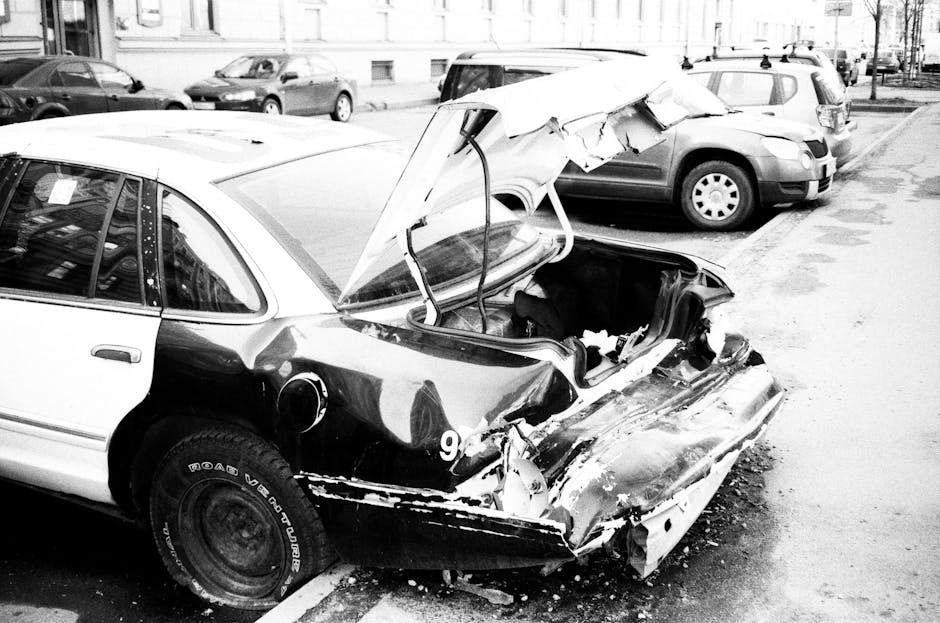
Car crashes inside the CITY OF STOCKTON play out at one of the busiest highway crossroads in Northern California. INTERSTATE 5 and STATE ROUTE 99 run parallel through the city and are tied together by the STATE ROUTE 4 CROSSTOWN FREEWAY, while surface arterials like HAMMER LANE, MARCH LANE, PACIFIC AVENUE (through the MIRACLE MILE), EL DORADO STREET, CHARTER WAY, WILSON WAY, AIRPORT WAY, and EIGHT MILE ROAD carry dense mixed traffic of commuters, cyclists, pedestrians, and the heavy trucks feeding the region's warehouses and the PORT OF STOCKTON. The STOCKTON POLICE DEPARTMENT's traffic division investigates collisions on city surface streets, the CALIFORNIA HIGHWAY PATROL handles the freeways and the Delta bridges, and the SAN JOAQUIN COUNTY SHERIFF covers unincorporated pockets that abut the city. Injury suits over $35,000 (unlimited civil jurisdiction) are filed in the SAN JOAQUIN COUNTY SUPERIOR COURT at the STOCKTON COURTHOUSE (180 E. Weber Ave.) downtown, where mandatory settlement conferences are standard before any case reaches trial, and California's pure comparative negligence rule apportions rather than bars a partially at-fault driver's recovery. Because the freeways and the street grid interlock so tightly at the I-5/SR-99 crossroads, a single crash can begin on a state highway and end on a city street, splitting jurisdiction and evidence between CHP and Stockton PD in ways that matter when the report and the eventual claim are assembled.
California is a traditional FAULT (tort) state with NO no-fault or personal-injury-protection system — the at-fault driver's liability insurer pays. Under SB 1107 (the Protect California Drivers Act), the minimum liability limits rose on January 1, 2025 to $30,000 per person, $60,000 per accident, and $15,000 property damage (Veh. Code §16056) — the first increase in decades, yet still routinely inadequate when a single trauma admission dwarfs the policy. UNDERINSURED and UNINSURED MOTORIST (UM/UIM) coverage under Insurance Code §11580.2 fills the gap, but only if the injured driver purchased it in advance — and that coverage is especially critical in Stockton, where uninsured-driver rates run high and many buyers carry only the minimum. PROPOSITION 213 (Civ. Code §3333.4) bars an uninsured driver — or one committing a DUI felony — from recovering non-economic (pain-and-suffering) damages even when the other driver was entirely at fault, and PROPOSITION 51 (Civ. Code §1431.2) makes multiple defendants severally, not jointly, liable for those non-economic damages, so each pays only its own percentage share. Pure comparative negligence under Li v. Yellow Cab Co. still lets a driver who was, say, 25 percent at fault recover 75 percent of the loss. Drivers can also carry their own MEDICAL PAYMENTS (MedPay) coverage, which pays medical bills regardless of fault and stacks on top of a liability recovery. Prop 51's several-liability rule has real bite in a multi-car pileup on a fogged-in freeway — a plaintiff must pursue each at-fault driver for that driver's own proportional slice of any non-economic award, so identifying and serving every potentially liable driver early is important.
Stockton's crash profile is shaped by fog, freight, and a super-commuter workforce. The city is a BEDROOM COMMUNITY for the Bay Area, and thousands of SUPER-COMMUTERS pour onto Interstate 205 and Interstate 580 (or ride the ACE commuter train) toward the Altamont Pass each morning, producing exhausted-driver and rush-hour collisions on the western approaches. Winter TULE FOG — the dense, ground-hugging valley fog — routinely drops visibility to near zero on I-5, SR-99, and the Delta bridges, and has fueled the massive chain-reaction pileups the San Joaquin Valley is infamous for. The warehouse-and-logistics boom at the crossroads, plus the PORT OF STOCKTON's ag exports, floods the highways with BIG RIGS and commercial trucks, and a heavy-truck crash opens the door to federal motor-carrier rules and far higher policy limits than a personal auto policy provides. DUI-related collisions cluster around downtown, the Miracle Mile nightlife, and Delta boat-launch weekends, and pedestrian and cyclist deaths concentrate on the wide, fast arterials — Charter Way, Wilson Way, El Dorado Street, and Airport Way — that cut through south and east Stockton. Agricultural traffic on the levee roads and Delta islands adds slow farm equipment to fast rural highways, a dangerous mix that produces its own severe rural crashes just outside the city.
Public-entity crashes carry the six-month trap. A collision with a CITY OF STOCKTON fleet vehicle, an RTD bus, a Caltrans vehicle, or one caused by a dangerous roadway condition triggers a written government claim within SIX MONTHS under Gov. Code §911.2 — presented to the STOCKTON CITY CLERK for the city, to the SAN JOAQUIN REGIONAL TRANSIT DISTRICT for transit, or to the Department of General Services' Government Claims Program for a state highway like I-5, SR-99, or the Crosstown Freeway — long before the two-year injury statute (CCP §335.1) or three-year property statute (CCP §338) would otherwise run. RIDESHARE crashes turn on the driver's app phase: with the app on but no ride matched, the transportation network company provides only $50,000/$100,000 bodily-injury and $25,000 property coverage (and the personal insurer often denies), while en route to or carrying a passenger triggers $1 million in commercial liability, established by subpoenaing Uber's or Lyft's trip and GPS data. COMMERCIAL TRUCK crashes — common given Stockton's freight economy — require immediate preservation of the tractor's electronic control module, the driver's hours-of-service logs, and the carrier's records, because a company will often dispatch its own rapid-response team to the scene within hours. The same logic applies to footage from a warehouse's security camera, a Port of Stockton gate camera, or a doorbell camera in a neighborhood like Lincoln Village or Brookside — the video that proves the light was red or a truck ran the stop is often overwritten within days, so identifying and preserving it is one of the first tasks in any serious city collision.
After a city crash, call 911 and let the STOCKTON POLICE DEPARTMENT or CHP document the scene; photograph vehicle positions, license plates, skid marks, and any nearby traffic or business cameras before anything moves; exchange license, registration, and insurance information; and seek medical evaluation within a day or two even for a seemingly minor injury, since whiplash and concussion symptoms often surface later and a treatment gap is what adjusters exploit to discount a claim. California law requires drivers to file an SR-1 with the DMV within 10 days of any injury, death, or over-$1,000 crash (Veh. Code §16000), independent of the police report, and insurers typically want both documents. Income-qualifying drivers can obtain minimum coverage through the CALIFORNIA LOW COST AUTOMOBILE PROGRAM (mylowcostauto.com), which is one practical answer to the region's high uninsured-driver rate. Injured residents can get help from CALIFORNIA RURAL LEGAL ASSISTANCE and LEGAL SERVICES OF NORTHERN CALIFORNIA, and the SAN JOAQUIN COUNTY BAR ASSOCIATION lawyer-referral service connects them with accident attorneys. The great majority of city accident attorneys work on a one-third contingency, so representation costs nothing up front and the fee is paid only from any recovery. Property-damage disputes — a contested total-loss valuation, a diminished-value claim on a repaired vehicle, or a rental-reimbursement fight — run on the three-year property statute (CCP §338) and can often be resolved directly with the insurer or through a complaint to the California Department of Insurance without a lawsuit. For serious injuries, though, the combination of expensive trauma care, the frequency of minimum-limits and uninsured drivers, and the six-month deadlines on any government defendant makes early legal advice the single most valuable step a Stockton crash victim can take.
Need legal documents after an accident?
Demand letters, release forms, and settlement agreements — ready in minutes.
Sponsored links. Affiliate disclosure · Compare all options