
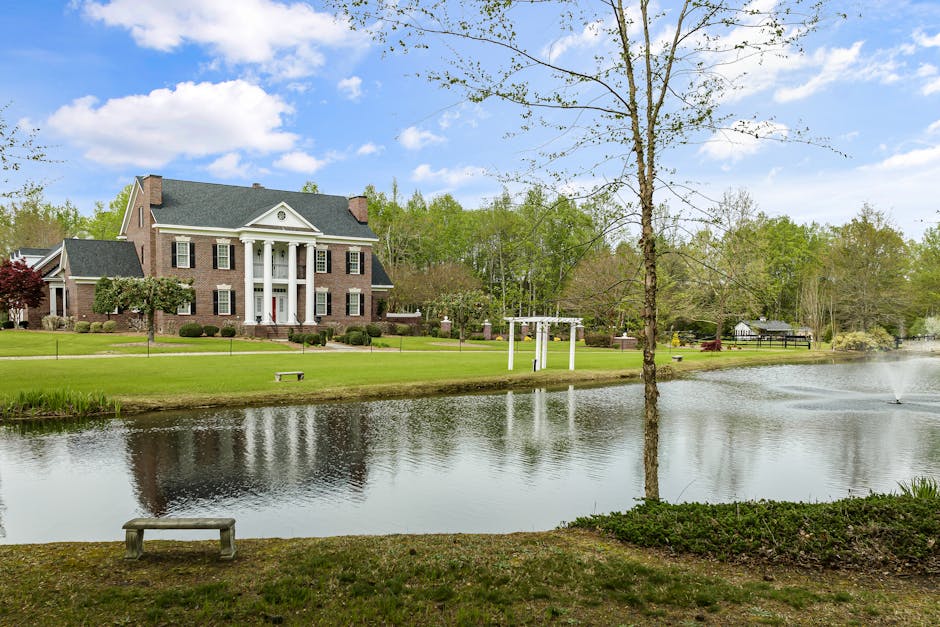
Real estate in BUCKS COUNTY spans a range that few Pennsylvania counties can match — from LEVITTOWN, the iconic postwar tract suburb whose Bristol Township and Bensalem blocks still trade as the region's entry-level housing stock, to the seven-figure river estates of NEW HOPE and the horse properties of Upper Bucks around QUAKERTOWN, with the Newtown and Yardley professional corridor in between. Every dispute about that property runs through the 7th JUDICIAL DISTRICT. The BUCKS COUNTY JUSTICE CENTER at 100 N Main St in DOYLESTOWN houses the Court of Common Pleas, where mortgage foreclosures, quiet-title actions, boundary disputes, easement fights, and ejectment proceedings are filed, and where the RECORDER OF DEEDS maintains the chain of title for every parcel in the county. Below that sit the MAGISTERIAL DISTRICT COURTS scattered across the county's municipalities — the venue for landlord-tenant evictions, which in Pennsylvania begin not in the county courthouse but before a magisterial district judge in a strip-mall courtroom, often within days. Understanding which court hears what is the first practical skill a Bucks property owner or tenant needs, because filing in the wrong one costs weeks that a foreclosure or a lockout does not give back.
Pennsylvania's property framework is distinctive in ways that consistently surprise people arriving from New Jersey or New York. Foreclosure here is JUDICIAL — a lender must file a complaint in the Court of Common Pleas in Doylestown, serve the homeowner, and obtain a judgment before a sheriff's sale can occur, which means a Bucks homeowner has a real courtroom and real deadlines rather than a purely administrative process. Before that complaint can even be filed, PENNSYLVANIA'S ACT 6 and ACT 91 require pre-foreclosure notices: a 30-day Act 91 notice on owner-occupied residential mortgages that must inform the homeowner of the right to apply for HEMAP — the HOMEOWNER'S EMERGENCY MORTGAGE ASSISTANCE PROGRAM, a genuinely unusual state-funded loan program that can cure a default caused by circumstances beyond the borrower's control. HEMAP has no analogue in most states, and the Act 91 notice starts a short clock in which a Bucks homeowner must contact a HUD-approved counseling agency to preserve access to it. Miss it and the program is gone. On the rental side, the LANDLORD AND TENANT ACT OF 1951 governs: security deposits are capped at TWO MONTHS' RENT during the first year of a lease and ONE MONTH thereafter, with deposits over $100 required to be held in an escrow account and interest paid to the tenant beginning in the third year. A landlord must return the deposit or provide an itemized list of damages within THIRTY DAYS of surrender, and failure to do so exposes the landlord to DOUBLE the amount wrongfully withheld. Evictions require written notice — generally 10 days for nonpayment, 15 or 30 days for lease-term violations depending on lease length, though written leases can and routinely do waive these notice periods entirely, which is why reading the lease matters more in Pennsylvania than in states where notice rights cannot be contracted away. A tenant who loses before the magisterial district judge has TEN DAYS to appeal to the Court of Common Pleas for a trial DE NOVO — a complete do-over — but must file a supersedeas and typically pay rent into escrow to stop the eviction meanwhile. PENNSYLVANIA HAS NO STATE RENT CONTROL, and no Bucks municipality has it.
The county-specific patterns start with water. THE DELAWARE RIVER defines Bucks County's eastern edge, and it floods — the 2004, 2005, and 2006 sequence hit YARDLEY, NEW HOPE, and WASHINGTON CROSSING in successive years, and Hurricane IDA in 2021 did it again. NESHAMINY CREEK produces flash floods of a different and more violent character, as the July 2023 WASHINGTON CROSSING flash flood that killed multiple people demonstrated. This is NFIP country, and the legal consequences are relentless: STANDARD HOMEOWNERS POLICIES EXCLUDE FLOOD, full stop, so coverage comes from the NATIONAL FLOOD INSURANCE PROGRAM or the growing private flood market. NFIP's RISK RATING 2.0 restructured premiums and, for many riverfront Bucks properties, sent them sharply upward — which now shows up at closings as a deal-killer when a buyer discovers the real carrying cost. Pennsylvania's SELLER DISCLOSURE LAW (68 Pa.C.S. Chapter 73) requires sellers of residential property to complete a disclosure statement covering known material defects, and flooding history and prior water damage are squarely on it. A Yardley seller who papers over a 2021 Ida basement is buying litigation. REPETITIVE LOSS properties, elevation certificates, and the substantial-improvement rule — where renovating beyond 50 percent of a structure's value triggers mandatory floodplain compliance — control what a New Hope owner can actually do with a historic riverfront building. Beyond water, Bucks has its own signature problems: the US STEEL FAIRLESS WORKS brownfield redeveloping as the KEYSTONE TRADE CENTER has driven a warehouse boom in Lower Bucks that generates zoning fights, truck-traffic litigation, and environmental due-diligence questions under Pennsylvania's ACT 2 LAND RECYCLING PROGRAM; Levittown's uniform postwar housing stock produces a steady docket of unpermitted additions discovered at resale, aging septic and lateral failures, and the aluminum wiring and asbestos issues of 1950s construction; and Upper Bucks agricultural land carries CLEAN AND GREEN (Act 319) preferential assessment whose ROLLBACK TAXES — seven years plus interest — ambush buyers who intend to develop.
The institutional map runs through the county's assessment and municipal structures. Pennsylvania property assessment is county-by-county chaos: each county sets its own base-year values, and the COMMON LEVEL RATIO published annually by the STATE TAX EQUALIZATION BOARD is the mechanism that translates a stale assessment into current market terms for appeal purposes. Bucks County has not conducted a countywide reassessment in decades, which means assessments reflect a long-ago base year and the CLR does the heavy lifting. A BUCKS COUNTY BOARD OF ASSESSMENT APPEALS petition — deadline generally August 1 for the following tax year, which residents miss constantly — is the remedy, and the math is mechanical: divide the assessment by the current CLR to get the implied market value, and if that number exceeds what the property is actually worth, an appeal has merit. The dynamic cuts both ways in Bucks: school districts themselves file appeals against recently-sold properties whose sale price exceeds the implied assessed value, a practice that has drawn litigation across Pennsylvania. Municipal land-use authority sits with the county's individual townships and boroughs under the PENNSYLVANIA MUNICIPALITIES PLANNING CODE (MPC), which channels zoning challenges through local ZONING HEARING BOARDS with a 30-DAY APPEAL window to Common Pleas — a short, jurisdictional, unforgiving deadline. Variances require proving unnecessary hardship; special exceptions are different animals entirely. Bucks municipalities are also unusually aggressive about open-space preservation, and conservation easements and agricultural security areas encumber a meaningful share of Middle and Upper Bucks land. If a Bucks municipality's negligence damages property — a failed storm sewer, a collapsed street — the POLITICAL SUBDIVISION TORT CLAIMS ACT applies, with local agencies immune except in nine narrow categories (including real property, streets, sidewalks, and utility service facilities), a $500,000 AGGREGATE CAP, and a SIX-MONTH WRITTEN NOTICE requirement that ends claims before they start. Note that this is Pennsylvania's statute, not any other state's immunity scheme, and the six-month notice is the trap.
The practical playbook for Bucks residents: LEGAL AID OF SOUTHEASTERN PENNSYLVANIA maintains a Bucks division in the county and handles tenant defense, foreclosure, and housing matters for income-eligible residents — it is the first call for anyone facing a magisterial district court eviction or an Act 91 notice. The BUCKS COUNTY BAR ASSOCIATION operates a lawyer referral service for those who do not qualify. HUD-APPROVED HOUSING COUNSELING AGENCIES serving the county are the mandatory gateway to HEMAP and the practical gateway to loss mitigation, and PENNSYLVANIA HOUSING FINANCE AGENCY administers HEMAP directly. For homeowners: when an Act 91 notice arrives, call a HUD counselor that week, not that month — the clock is short and the program closes. Do not ignore a foreclosure complaint; a default judgment in Doylestown ends the case without anyone hearing your defenses, and Pennsylvania courts do entertain challenges to standing, notice compliance, and servicing errors. For tenants: photograph everything at move-in and move-out and provide a forwarding address in writing at surrender, because the 30-day itemization clock and the double-damages remedy both depend on it. Read the lease for a notice waiver before assuming you have 10 or 30 days. If you lose before the magisterial district judge, the TEN-DAY appeal to Common Pleas with a supersedeas is a real second chance that most tenants never use. For buyers: order the seller disclosure and read the flood section twice, pull a FEMA flood map and an elevation certificate for anything near the Delaware or the Neshaminy, get a real NFIP quote before removing the mortgage contingency, and never buy Upper Bucks acreage without asking whether Clean and Green rollback taxes attach. For everyone: title insurance is not optional in a county where Levittown deeds have passed informally through families for seventy years, and a TANGLED TITLE — where the person living in the house is not the person on the deed — is far more common in Lower Bucks than anyone admits until an estate opens.
Need real estate legal documents?
Leases, purchase agreements, quit-claim deeds — state-specific templates.
Sponsored links. Affiliate disclosure · Compare all options