
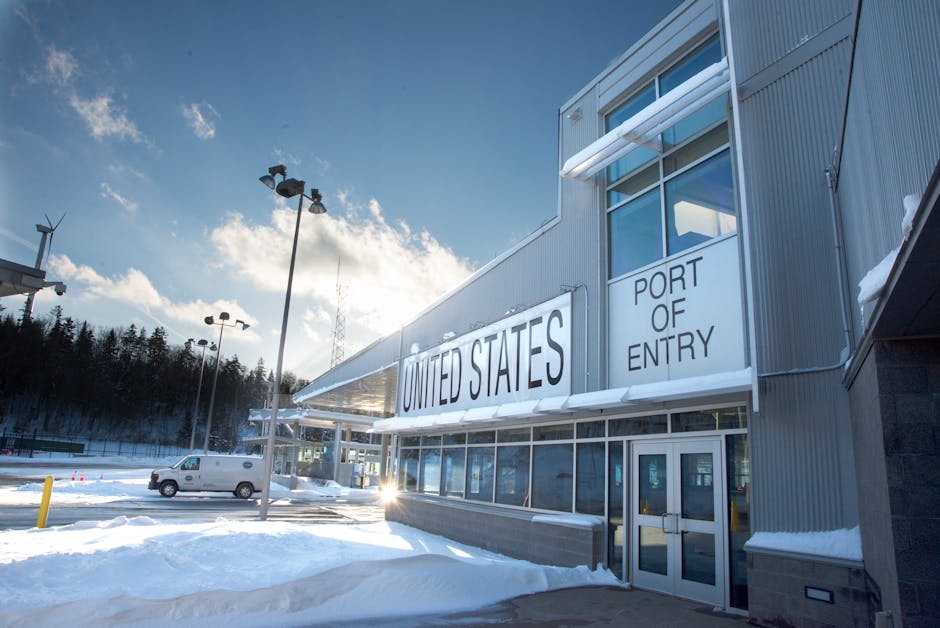
Immigration law in Alaska operates under a geographic constraint that shapes every aspect of practice: there is only one USCIS field office in a state larger than Texas, California, and Montana combined. The USCIS Anchorage Field Office (620 East 10th Avenue, Suite 102, Anchorage, AK 99501) serves all of Alaska's immigration needs, meaning that a Russian Orthodox parishioner in Kodiak, a Filipino cannery worker in Kodiak or Dutch Harbor, a Marshallese COFA citizen in Anchorage, and a North Slope engineer sponsored under an H-1B petition by a Prudhoe Bay contractor must all deal with the same single office — either in person in Anchorage or through remote teleconference. The logistical burden of immigration compliance falls heavily on rural Alaskans, many of whom must pay for flights to Anchorage simply to attend biometric appointments or naturalization ceremonies that residents of the lower forty-eight can reach by car.
Alaska's immigration courts are housed at the federal courthouse in Anchorage (222 West 7th Avenue, Anchorage, AK 99513). ICE Enforcement and Removal Operations for Alaska falls under the Seattle Field Office (12500 Tukwila International Boulevard, Seattle, WA 98168), which has a sub-office presence in Anchorage. Detained immigrants in Alaska may be held at the Anchorage Correctional Complex (888 East 4th Avenue, Anchorage) or transferred to the Northwest ICE Processing Center in Tacoma, Washington. Appeals from the Anchorage Immigration Court go to the Board of Immigration Appeals (5107 Leesburg Pike, Suite 2000, Falls Church, VA 22041) and then to the Ninth Circuit Court of Appeals, which hears Alaska immigration appeals at its San Francisco or Seattle panel sessions. The Ninth Circuit's immigration jurisprudence — protective of asylum seekers from Central America and deferential to the BIA in many country-conditions determinations — governs Alaska immigration litigation and differs significantly from the Fifth Circuit framework that governs Texas border-region immigration cases.
Alaska's largest immigrant communities reflect the state's unique economic geography. The Filipino community — among the largest and most established immigrant groups in Anchorage — traces its Alaska roots to the cannery industry of the early twentieth century, when Filipino workers were recruited for salmon canneries throughout Southeast Alaska and the Alaska Peninsula. Today, Filipino nurses and allied health workers are employed at Providence Alaska Medical Center (3200 Providence Drive, Anchorage, AK 99508), Alaska Regional Hospital (2801 DeBarr Road, Anchorage, AK 99508), and Bartlett Regional Hospital in Juneau; Filipino military spouses populate the neighborhoods around Joint Base Elmendorf-Richardson (JBER); and Filipino seafood-processing workers continue to staff canneries in Kodiak, Bristol Bay, and Southeast Alaska. Immigration petitions for Filipino healthcare workers under EB-2 and EB-3 preference categories have faced years-long backlogs due to per-country limits despite Alaska healthcare employers' acute staffing shortages.
Compact of Free Association (COFA) citizens from the Marshall Islands, the Federated States of Micronesia, and the Republic of Palau have unique immigration status in Alaska. Under the Compacts of Free Association, citizens of these Pacific Island nations may live and work in the United States without immigrant visas or work permits. The Marshallese community in Anchorage is historically connected to the legacy of U.S. nuclear weapons testing at Bikini Atoll and Enewetak Atoll, and many Marshallese families have relocated to the continental United States and Alaska. COFA citizens are not lawful permanent residents and are not eligible for most federal benefit programs (a restriction imposed by PRWORA in 1996, partially restored by the 2020 and 2023 appropriations acts); they face unusual legal status questions when applying for drivers' licenses, state benefits, or professional licenses in Alaska, and their children born in the U.S. are U.S. citizens by birth. Lutheran Social Services of Alaska (1401 Rudakoff Street, Anchorage, AK 99508) serves as Alaska's primary refugee resettlement agency contractor, resettling Somali, South Sudanese, Bhutanese-Nepali, Congolese, and Ukrainian refugees in Anchorage and coordinating with the state's Office of Refugee Assistance.
Alaska Native citizenship is grounded in the Indian Citizenship Act of 1924 (8 U.S.C. sec. 1401(b)), which granted U.S. citizenship to all Native Americans (including Alaska Natives) born in the United States, regardless of tribal enrollment. Alaska Native peoples are therefore U.S. citizens at birth by federal statute, and the 229 federally recognized Alaska tribes do not confer a separate immigration status. However, for Alaska Natives with close family ties in Canada — particularly Tlingit and Haida peoples in Southeast Alaska with relatives in British Columbia and Yukon — the Jay Treaty of 1794 (incorporated by INA sec. 289, 8 U.S.C. sec. 1359) provides Canadian-born tribal members certain border-crossing rights at the Alaska-Canada border crossings on the Alaska Highway (at Tok/Beaver Creek) and at the Skagway/Fraser connection. Additionally, H-2A agricultural visa workers play only a minimal role in Alaska (the state lacks large-scale agriculture), but H-2B workers are significant in seafood processing — particularly at Bristol Bay salmon canneries where both direct hire and H-2B contractors supply labor for the six-to-eight-week peak season from late June through August.
Military-connected immigration in Alaska is significant given the state's large active-duty and National Guard population at JBER (Joint Base Elmendorf-Richardson, home of the 3rd Wing and 25th Infantry Division elements), Fort Wainwright near Fairbanks, Eielson Air Force Base near Fairbanks, Clear Space Force Station near Nenana, and multiple smaller Army Reserve and ARNG installations. Non-citizen servicemembers may expedite their naturalization under INA sec. 328-329 (8 U.S.C. sec. 1439-1440) after as little as one year of honorable service; spouses of U.S. citizen servicemembers may use military parole in place or consular processing depending on their status. Immigration attorneys in Anchorage frequently represent servicemember spouses and families navigating the intersection of military orders, PCS moves, and immigration documentation in a state where USCIS appointments are limited and remote processing is the norm.
Need immigration-related legal documents?
Affidavits, power of attorney, notarized forms — 150+ document types.
Sponsored links. Affiliate disclosure · Compare all options