
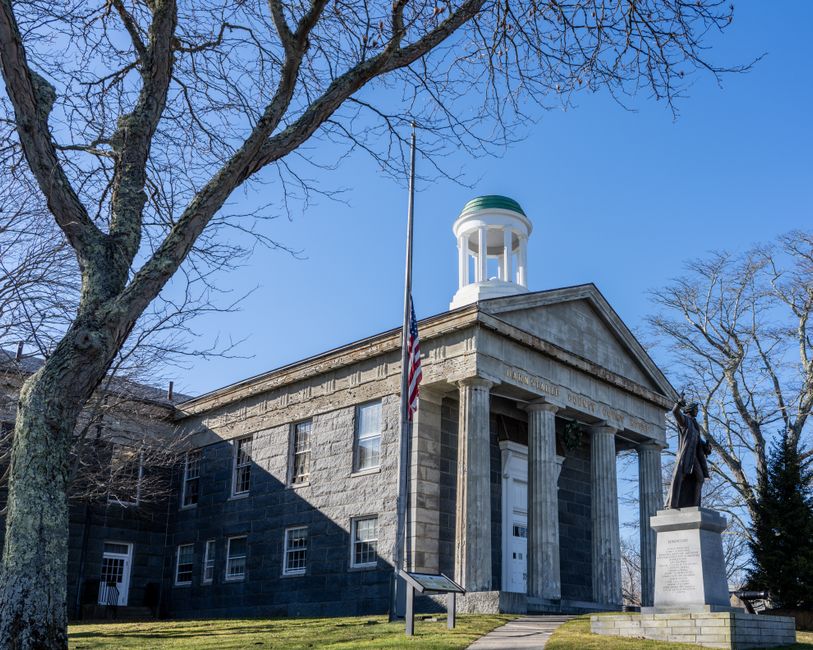
Franklin County charges its citizens in the shadow of its own statehouse — COLUMBUS is simultaneously Ohio's capital, its largest city, and the anchor of a county of roughly 1.33 million people still growing faster than anywhere else in the state. Every felony here converges on the FRANKLIN COUNTY COURT OF COMMON PLEAS at 345 S. High Street downtown, where a grand jury indicts and a randomly assigned judge carries the case to plea or trial. Almost nothing starts there. The FRANKLIN COUNTY MUNICIPAL COURT is the system's front door — arraignments, bond, preliminary hearings on felony complaints, and a misdemeanor docket whose sheer volume makes it one of the busiest courthouses in the Midwest. Charging authority splits by geography and grade: the FRANKLIN COUNTY PROSECUTING ATTORNEY controls felony presentments countywide, while the COLUMBUS CITY ATTORNEY prosecutes misdemeanors arising inside city limits — two offices with different diversion menus, different reduction cultures, and different appetites for trial. The suburbs add a third tier, because Dublin, Westerville, Whitehall, Reynoldsburg, Grove City, and the rest of the I-270 ring run their own police departments and prosecutors, and some operate MAYOR'S COURTS, an Ohio institution handling minor local charges outside the regular judicial system. The consequence for a defendant is concrete rather than academic: identical conduct can draw materially different offers depending on which side of a municipal line the cruiser's lights came on, which is why the first question a fluent Franklin County defense lawyer asks is not what happened but where.
Ohio's criminal code has been rewritten faster in the last five years than in the prior thirty, and the changes decide cases here daily. CASH BAIL survived the reform wave: when the Ohio Supreme Court held in DUBOSE V. MCGUFFEY (2022) that a bail amount could address only flight risk and not danger, voters answered that November with a CONSTITUTIONAL AMENDMENT expressly adding PUBLIC SAFETY to the factors a judge weighs in setting the figure — so a Municipal Court bond argument is now a genuine hearing about dangerousness and community ties, not a number read off a schedule. STAND YOUR GROUND arrived in 2021, erasing any duty to retreat for a person lawfully present anywhere and layering onto Ohio's CASTLE DOCTRINE presumption inside homes and occupied vehicles; once self-defense is properly raised, the state must disprove it beyond a reasonable doubt. PERMITLESS CONCEALED CARRY followed in June 2022 for adults 21 and over, quietly retiring a whole category of license-based gun charges while leaving the heavy ones untouched — HAVING WEAPONS WHILE UNDER DISABILITY, the possession offense for anyone carrying a qualifying felony or drug record, remains a Common Pleas staple, and IMPROPERLY HANDLING FIREARMS IN A MOTOR VEHICLE still converts traffic stops into felonies. MARIJUANA became legal for adults 21 and over when Issue 2 took effect in December 2023 — 2.5 ounces, six home-grown plants per adult — though public use, unlicensed sales, under-21 possession, and drugged driving all remain chargeable, and Ohio employers may still test and fire. Two mercy valves complete the picture: INTERVENTION IN LIEU OF CONVICTION (R.C. 2951.041), a statutory treatment diversion that ends an eligible felony in outright dismissal, and 2023's SB 288, which made most non-violent convictions sealable and some fully expungeable.
Local enforcement gives those statutes their Franklin County shape. The COLUMBUS DIVISION OF POLICE has been under sustained reform pressure since 2020 — the city paid substantial settlements over its handling of that summer's protests, built out body-worn camera coverage, and restructured use-of-force review through civilian oversight created by charter amendment — which means video exists for most encounters, and a preservation demand filed in week one is worth more than any motion filed in month six. Enforcement geography is legible to anyone who lives here. The OHIO STATE UNIVERSITY campus district along HIGH STREET generates a perpetual docket of underage consumption, fake-ID, open-container, and disorderly conduct cases that spikes on football Saturdays and during welcome week — and OSU students face a parallel STUDENT CONDUCT proceeding whose sanctions can land faster and hit harder than the criminal case, sometimes threatening enrollment and visa status before the first pretrial. Gun counts cluster in traffic stops on I-70, I-71, and the reconstructed SPLIT interchange downtown, where lane shifts and construction geometry generate the stops that generate the searches. And the county's demography sits in every arraignment room: Columbus is home to AMERICA'S SECOND-LARGEST SOMALI COMMUNITY, concentrated along the Northland and MORSE ROAD corridor, plus one of the nation's largest BHUTANESE-NEPALI populations, Black neighborhoods on the Near East Side and in LINDEN shaped by a documented redlining history, and a growing Latino community on the HILLTOP and the West Side. Interpreter demand in Franklin County courtrooms is constant, and for non-citizens every plea carries federal freight that has to be priced before the deal is signed rather than after.
The institutional map rewards people who know it exists. The Municipal Court runs specialized dockets that convert punishment tracks into treatment tracks for those who qualify — including CATCH COURT, the nationally emulated docket for human-trafficking survivors whose charges trace back to their own victimization, alongside programs aimed at defendants driven by addiction or mental illness. In Common Pleas, INTERVENTION IN LIEU OF CONVICTION is the statutory version of the same idea: an eligible defendant pleads guilty, the plea is held in abeyance while a court-supervised treatment plan of at least a year runs, and completion produces a DISMISSAL with sealing available afterward, while failure converts the held plea into a conviction and sentencing follows. The carve-outs matter — OVI is excluded from ILC by statute, and offenses of violence generally disqualify. For non-citizens the geography is punishing. All Ohio removal proceedings are venued at the CLEVELAND IMMIGRATION COURT, a two-hour drive north, which turns every detained immigration case into a logistical crisis for a Columbus family, and PADILLA V. KENTUCKY obligates defense counsel to advise on deportation consequences before any plea — a duty that is anything but theoretical in a county with this much New-American density. Ohio has no statewide TRUST act, and cooperation between county jails and federal immigration authorities varies, so a custody decision in the criminal case can quietly become an immigration decision. Meanwhile SB 288 has made the sealing docket one of the fastest-growing lines of work in the building: convictions that once permanently blocked employment, housing, and licensure are now routinely sealed on application to the sentencing court.
Help exists here, and it is oversubscribed. The FRANKLIN COUNTY PUBLIC DEFENDER staffs arraignments and represents indigent defendants in both courthouses — ask for appointed counsel at the very first appearance, because it costs nothing and preserves everything. The LEGAL AID SOCIETY OF COLUMBUS handles the civil shrapnel a criminal case throws off, from eviction exposure to license suspensions to benefits terminations, and the MORITZ COLLEGE OF LAW clinics at Ohio State add supervised student-attorney capacity. Organizations serving New Americans — CRIS, US TOGETHER, and ECDC among them — bridge language and system-navigation gaps that no interpreter appointment fully closes. The playbook itself is unglamorous and decisive. Say nothing to investigators beyond identifying yourself, and ask for a lawyer out loud. Never consent to a search of a car, a phone, or a home, because consent forgives defects that would otherwise suppress the evidence. Treat arraignment as the first real hearing, since bond under the post-2022 framework is argued rather than assumed — send family with proof of work, housing, and ties. Demand preservation of body-worn, cruiser, and jail video immediately, before retention windows cycle. Screen for ILC, the specialty dockets, and City Attorney diversion before anyone discusses a plea, because those doors close in the first weeks of a case rather than the last. Have every non-citizen plea vetted in writing. And calendar SB 288 sealing eligibility the day the case ends: in a labor market anchored by the STATE OF OHIO and OSU, by JPMORGAN CHASE's largest employee hub anywhere, by NATIONWIDE, and by the INTEL fabrication plants rising in New Albany, a sealed record is not a symbolic victory but an economic asset that compounds for the rest of a working life.
Need legal documents for your defense?
Character references, release forms, and legal correspondence templates.
Sponsored links. Affiliate disclosure · Compare all options